PHOENIX, ARIZONA / RESEARCH SERIES
Small radios.
Longer reach.
Know the links.
A practical guide to LoRa mesh, Reticulum, and satellite connections—from two pocket radios to a possible White Tanks gateway.
Start with the basics →Browse all seven articles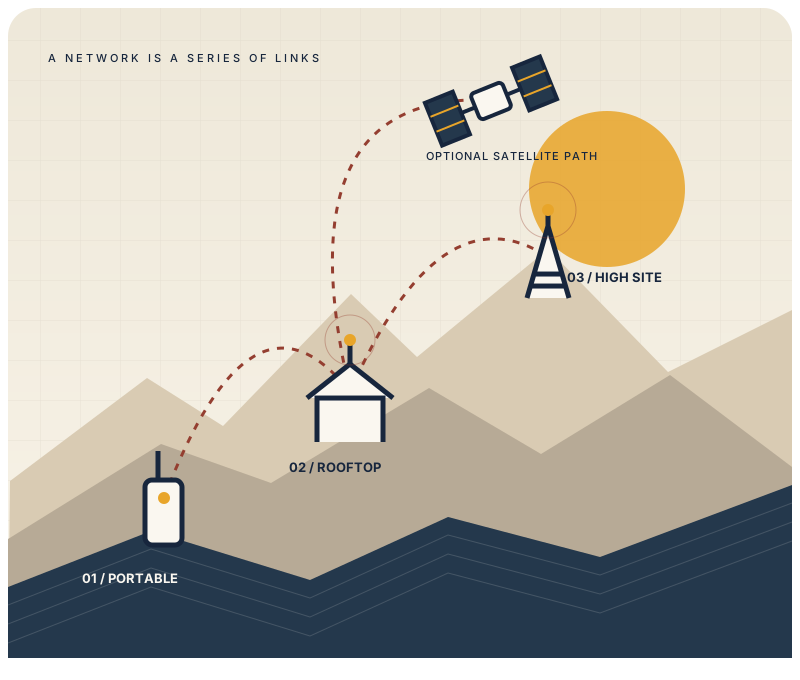
Conceptual links, not a coverage map
Your Elmer, in writing. Learn what each layer does, choose equipment for the job, and separate a promising design from a measured result.
THE READING PATH
From first packet
to a wider network.
7 articles
Foundations
LoRa, mesh & private messaging
Start with the radio. Understand what travels over it, who can read it, and what your ham license changes.
Networks & community
Two meshes, one Valley
Compare the protocols, find Arizona participants, and choose the network your radio can actually reach.
Equipment
Choose a radio you will carry
A focused buying guide for two people, a neighborhood node, and a future site installation.
Field planning
From a roof to White Tanks
Build useful coverage, measure the return path, and design for Arizona heat and a shared radio site.
Networking
Reticulum: beyond one radio network
Understand the networking stack, its messaging apps, and what an RNode adds to hardware you already own.
Satellite & gateways
MeshSat & the satellite escape route
How a mesh gateway, Reticulum, and a RockBLOCK 9704 can work together—and what is still experimental.
Internet & resilience
Starlink as the backhaul
Use satellite internet with Reticulum or MeshSat, understand NAT, and calculate the energy tradeoff.
No matching article. Try a broader term or clear the search.
CHOOSE YOUR STARTING POINT
What are you
trying to connect?
Different jobs need different links. This selector explains the tradeoffs; it does not predict coverage.
START LOCAL
Meshtastic or MeshCore
Begin with two supported radios and the local community's current settings. Test two-way RF coverage before choosing fixed infrastructure.
Compare the networks →TAKE IT OUTSIDE
A map pin is a lead.
A reply is evidence.
Use one repeatable worksheet to record direct links, relayed paths, acknowledgments, battery behavior, and what happens when internet access goes away.
Download the field worksheet ↓- IdentifyHardware, firmware, antenna, settings
- SeparateDirect RF, relayed RF, internet-assisted
- MeasureBoth directions, acknowledgments, latency
- RepeatNormal carrying position and actual destinations
KEEP THE LAYERS STRAIGHT
A short radio-to-network glossary.
LoRa
A radio modulation used for low-rate, long-range communication. It does not by itself specify a messaging network.
Meshtastic / MeshCore
Separate mesh protocols and applications. Similar supported hardware does not make their normal networks interoperable.
LoRaWAN
A separate network architecture commonly used for sensor gateways. Do not confuse it with a Meshtastic-ready device.
Reticulum / RNode / LXMF
Reticulum supplies networking, RNode supplies a compatible radio interface, and LXMF supplies messaging above Reticulum.
MeshSat
A pre-release gateway project that connects supported local radio and external bearers. Its components have different evidence levels.
RockBLOCK / Iridium IMT
RockBLOCK 9704 is modem hardware; Iridium IMT is the paid satellite message service it uses.
Starlink backhaul
An internet connection that a gateway can use to reach remote peers or services. It remains dependent on terminal power and provider infrastructure.
CGNAT
Carrier-grade NAT shares public IPv4 access. An outbound connection is often more practical than trying to expose an inbound listener.
Acknowledgment
A return indication of receipt. What it proves depends on whether it came from a relay, destination radio, or application.
Part 15 / Part 97
Different US operating rules. Being a licensed amateur does not require using amateur privileges for every radio transmission.